

Maxillofacial & facial skeletal surgery
Maxillofacial & Facial Skeletal Surgery in Los Angeles
The jaws, the chin, the cheekbones, and the balance between one side of your face and the other: at Cosmetic Doc, Dr. Husam Elias treats the facial skeleton itself. Board certified in oral and maxillofacial surgery, he corrects jaw, proportion, and asymmetry problems with function and appearance in mind.
What Is Maxillofacial Surgery?
Maxillofacial surgery is surgery of the bones and deeper structures of the face: the upper jaw (maxilla), the lower jaw (mandible), the chin, the cheekbones, and the joints and tissues that connect them. The word joins "maxilla," the upper jawbone, with "facial," and the specialty spans everything from correcting a misaligned bite to rebuilding a face after serious injury. At Cosmetic Doc, maxillofacial surgery means treating the facial skeleton with two goals held side by side: how your face works and how it looks. The two are often linked: a lower jaw that sits too far back can affect the bite and the airway while also softening the chin and neckline.
That focus is what makes this part of our practice different. Here, maxillofacial surgery is about jaws that grew out of balance, faces that are noticeably asymmetric, chins and jawlines that are underdeveloped or overly prominent, and complex facial problems that many cosmetic practices consider outside their scope. If you have been told your concern "is in the bone," this is where it belongs.
A Rare Combination of Training
Most cosmetic surgeons are trained to work on soft tissue: skin, fat, and muscle. Far fewer are also trained to move, reshape, and rebuild the bones of the face. Dr. Husam Elias is one of them. He holds both a Doctor of Dental Medicine and a Doctor of Medicine degree, completed his oral and maxillofacial surgery residency at Case Western Reserve University, where he served as chief resident, and is board certified by the American Board of Oral & Maxillofacial Surgery.
Before establishing his practice in Southern California, Dr. Elias served as Section Head of Oral & Maxillofacial Surgery at the Cleveland Clinic, where he was part of the team behind the first U.S. civilian face transplant. That experience with the most demanding problems in facial surgery informs how he approaches every skeletal case today, from a single chin procedure to double jaw surgery.
He is also board certified in cosmetic surgery and facial cosmetic surgery. For you, that means one surgeon evaluates the bone, the soft tissue, and the aesthetic result together, and plans one coordinated treatment instead of sending you between specialists.
Explore by concern
Maxillofacial Procedures and Concerns We Treat
Each guide explains a specific skeletal concern, the treatment options that address it, and what planning and recovery involve with Dr. Elias.
-
Corrective Jaw Surgery
Orthognathic surgery for underbites, overbites, open bites, and uneven jaws, planned with 3D imaging and coordinated with your orthodontist for a balanced bite and profile.
Explore Corrective Jaw Surgery -
Facial Asymmetry
Diagnosis and treatment of uneven jaws, chins, and cheeks, from fat transfer and implants to chin and jaw surgery, with a focus on natural balance rather than perfect symmetry.
Explore Facial Asymmetry -
Chin & Jaw Surgery
Sliding genioplasty, chin advancement, reduction, and narrowing, plus jawline and mandibular angle contouring, planned at the level of the bone to balance your profile.
Explore Chin & Jaw Surgery -
Facial Skeletal Contouring
V-line surgery, jaw reduction, cheekbone reduction, and custom facial implants that reshape the overall width and outline of the face, guided by 3D imaging and digital planning.
Explore Facial Skeletal Contouring -
Facial Reconstruction & Revision
Elective correction of healed facial fractures, complex deformities, and unsatisfying results from previous surgery, including revision rhinoplasty and secondary facelift, guided by reconstructive training.
Explore Facial Reconstruction & Revision -
Asian Facial Surgery
Asian rhinoplasty, double eyelid surgery, V-line and cheekbone contouring, jaw and chin procedures, and fat transfer, planned for harmony that honors your heritage, close to home in Los Angeles.
Explore Asian Facial Surgery
Concerns Rooted in the Facial Skeleton
Many concerns that patients first try to address with fillers or soft-tissue surgery actually begin in the bone. Common examples we evaluate include:
- Jaw discrepancies: An upper or lower jaw that sits too far forward, too far back, or rotated can cause an underbite, overbite, or open bite, and can affect chewing, lip closure, and your profile. Learn more about corrective jaw surgery.
- Facial asymmetry: One side of the face may look longer, fuller, or shifted because of uneven jaw growth, a jaw joint condition, injury, or earlier surgery. See our guide to facial asymmetry correction.
- Chin and jawline proportion: A recessed, overly long, or off-center chin, or a jawline that looks weak or overly wide, can change the balance of the entire face.
- Midface and cheek structure: Flat or uneven cheekbones and an underdeveloped midface can make the face look tired or out of proportion, even when the skin is healthy.
- Complex and revision cases: Deformity after trauma, earlier surgery, or a condition present from birth often calls for a surgeon comfortable working with bone, grafts, and scar tissue.
3D Imaging and Virtual Surgical Planning
Skeletal surgery rewards precision, and precision starts long before the operating room. At your consultation, we may use cone beam computed tomography (CBCT), a low-dose 3D X-ray scan, to see your jaws, chin, cheekbones, and airway in three dimensions. Paired with facial photographs and bite records, the scan shows exactly where a discrepancy lies and how much the bone needs to move.
For jaw and skeletal procedures, Dr. Elias uses digital surgical planning to rehearse the operation on a virtual model of your face. He can test different movements, see how the bones will fit together, and preview how the changes may affect your profile before surgery. You see the same images he does, explained in plain language, so the reasoning behind your plan is never a mystery. When appropriate, the plan is used to create custom surgical splints or guides that help carry out each movement accurately. Learn more about our surgical technology and accredited facility.
Why Cosmetic Doc
Why Patients Choose Us for Facial Skeletal Surgery
Surgery on the bones of the face calls for a different kind of training. Here is what that training means for your care.
-
Medical & Dental Degrees
As both an MD and a DMD, Dr. Elias understands the bite, the jaws, and the face as one connected system, which matters whenever surgery changes both function and appearance.
-
Maxillofacial Board Certification
Dr. Elias is board certified by the American Board of Oral & Maxillofacial Surgery, the specialty that trains surgeons to reposition, reshape, and reconstruct the bones of the face.
-
Academic Surgical Background
As former Section Head of Oral & Maxillofacial Surgery at the Cleveland Clinic, Dr. Elias has managed some of the most complex facial problems a surgeon can encounter.
-
3D-Planned Precision
CBCT imaging and virtual surgical planning map every bone movement in advance, so you can see your plan, ask questions about it, and understand it before surgery.
-
Aesthetic Judgment Built In
Triple board certification in cosmetic, facial cosmetic, and maxillofacial surgery means every skeletal plan is also judged by how natural and balanced your face will look.
-
One Surgeon Throughout
The surgeon who reviews your scans is the surgeon who performs your procedure and guides your recovery, so nothing is lost between consultation and final result.
Where Skeletal and Soft-Tissue Surgery Meet
Bone sets the stage for everything above it. A change to the chin can alter how the nose looks, a lower jaw moved forward can sharpen the neckline, and a better-supported midface can soften the look of tired eyes. That is why the most natural results often come from treating the skeleton and the soft tissue together, or in a thoughtful sequence.
Dr. Elias plans these combinations routinely. A patient with a recessed chin may benefit from chin advancement paired with rhinoplasty to bring the profile into balance. Someone with an uneven jawline may need skeletal correction first, then fat grafting or implants to fine-tune the contour. If your concern turns out to be mainly soft tissue, our cosmetic facial contouring options may serve you better, and you can explore facelift, eyelid, and other procedures in our full cosmetic surgery practice. You will never be steered toward bone surgery when a simpler approach can give you the result you want.
Depending on the procedure, surgery takes place in our AAAHC-accredited surgery center in Pasadena or in an accredited surgical facility or hospital appropriate to the procedure. Anesthesia ranges from IV sedation to general anesthesia.
Cost, Insurance, and Your Consultation
The cost of maxillofacial surgery depends on the procedure, its complexity, the anesthesia required, facility fees, and whether skeletal and soft-tissue procedures are combined. You will receive a personalized, written quote after your consultation. Skeletal procedures performed purely for appearance are generally not covered by insurance, but corrective jaw surgery and reconstruction for documented functional problems may qualify for medical insurance; our team can help verify your benefits. We accept cash, checks, major credit and debit cards, and financing plans.
To find out whether your concern begins in the facial skeleton, schedule a consultation with Cosmetic Doc at our Pasadena office or Sherman Oaks office. Patients travel from across Los Angeles for this level of facial skeletal expertise.
Your surgeon
Meet Your Surgeon
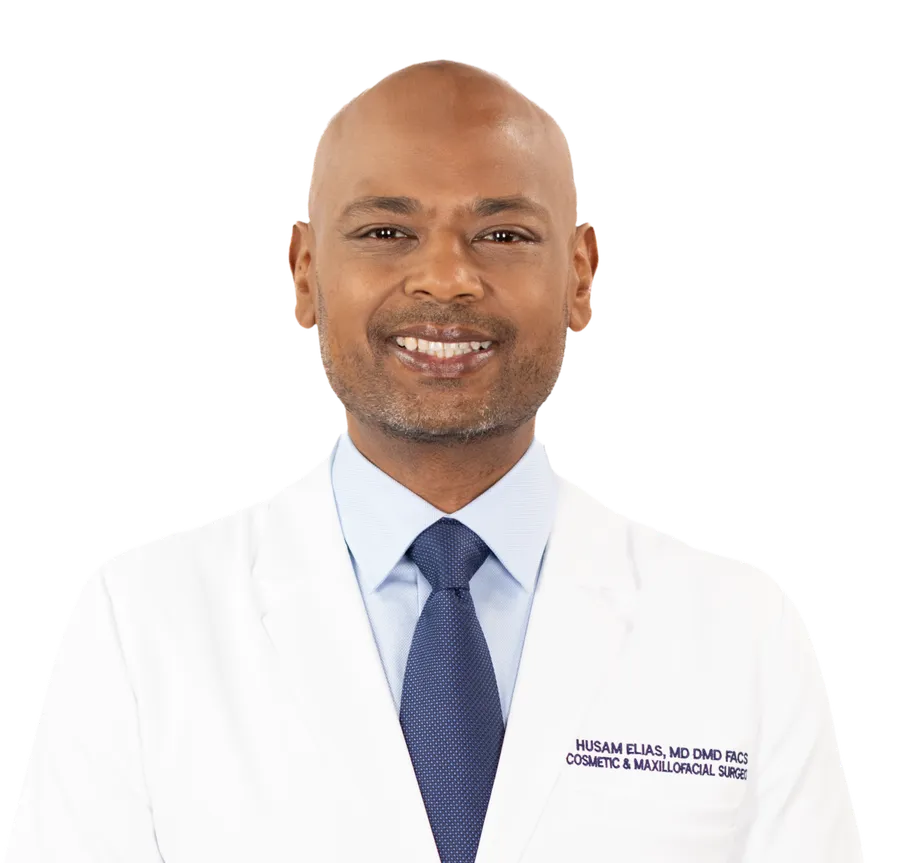
Dr. Husam Elias
MD, DMD, FACS
Dr. Husam Elias, MD, DMD, FACS, is a triple board-certified cosmetic surgeon who is also board certified in oral and maxillofacial surgery. He personally plans, performs, and follows every facial skeletal procedure, bringing academic surgical training to each consultation.
Questions patients ask
Maxillofacial Surgery FAQs
What is the difference between oral surgery and maxillofacial surgery?
Oral surgery usually refers to procedures inside the mouth, such as removing teeth. Maxillofacial surgery extends to the bones of the face: the upper and lower jaws, chin, cheekbones, and their joints. At Cosmetic Doc, our maxillofacial practice focuses on jaw position, facial proportion, asymmetry, and complex facial skeletal problems.
Why see a maxillofacial surgeon for a cosmetic concern?
Some concerns, such as a weak chin, an uneven jaw, or a face that looks longer on one side, begin in the bone. Soft-tissue treatment alone may only camouflage them. A surgeon trained in both maxillofacial and cosmetic surgery can identify the true cause and correct it at its source.
Do I need braces before jaw surgery?
Most patients having corrective jaw surgery work with an orthodontist before and after surgery so the teeth fit together once the jaws are repositioned, and Dr. Elias coordinates the timeline with your orthodontist. Procedures that reshape the chin, cheekbones, or jaw angles without moving the bite usually do not require orthodontics.
What is virtual surgical planning?
Virtual surgical planning uses a 3D CBCT scan of your facial skeleton to build a digital model. Dr. Elias uses it to test bone movements, check how the jaws will fit together, and preview how your profile may change. When helpful, the plan guides custom splints or surgical guides used during your procedure.
Is maxillofacial surgery covered by insurance?
It depends on the reason for surgery. Corrective jaw surgery or reconstruction for documented functional problems, such as a bite that makes chewing difficult, may qualify for medical insurance, and our team can help verify your benefits. Procedures performed purely to change appearance are generally elective and not covered.
How long is recovery after facial skeletal surgery?
Recovery depends on the procedure. After chin or contouring surgery, many patients return to desk work within one to two weeks, while jaw surgery typically requires two to three weeks away from work or school and a modified diet for several weeks. Swelling fades gradually over several months.
Can skeletal and cosmetic procedures be done together?
Often, yes. Chin surgery is commonly paired with rhinoplasty, and jaw or contouring procedures can be combined with fat grafting or soft-tissue refinement. Dr. Elias recommends combinations only when they are safe for your health and the total operating time, and he explains how combining affects your recovery.
Start here
Your Choice for Expert Cosmetic Surgery in Pasadena & Sherman Oaks
Cosmetic Doc delivers board-certified cosmetic surgery with care, compassion, and artistry. From facelifts and rhinoplasty to body contouring, Dr. Husam Elias pairs dual MD/DMD training with an on-site AAAHC-accredited surgery center for the safest, most natural-looking results. Contact our Pasadena or Sherman Oaks office today to schedule your consultation.